


Home » Truck & Trailer Solutions » Truck & Trailer Kits
In the commercial vehicle sector, the chassis frame is the “skeleton” that carries the vehicle’s weight, transmits power, and ensures driving safety. Its performance directly determines the vehicle’s load capacity, durability, and operational efficiency. TOPOLOGROUP provides chassis frame kits to manufacturers through standardized and modular designs. Our galvanized steel chassis frame kits are specifically designed for heavy-duty applications, achieving multiple optimizations in materials, processes, and structure.
Materials & Coatings
| Item | Specification | Key Advantages |
| Base Material | Q345 Carbon Steel | A low-alloy, high-strength structural steel with yield strength ≥345 MPa and tensile strength of 470–630 MPa, far exceeding ordinary carbon steel. It can withstand heavy loads without deformation and maintains excellent low-temperature impact toughness (stable even at -40℃), making it ideal for operations in cold regions. |
| Galvanized Coating | 100 μm thickness | The coating thickness is 1.2–2 times that of standard hot-dip galvanization (50–80 μm), forming a dense “zinc barrier layer” that isolates air, moisture, and corrosive media (such as de-icing salt or seawater salinity). It achieves a salt spray resistance of ≥1000 hours, significantly extending chassis frame service life (while uncoated carbon steel frames typically show severe rust within 2–3 years, this kit extends durability to 8–10 years). |
| Stamped Sheet Thickness | 5–10 mm (optional) | Thickness options meet different heavy-duty applications: 5–6 mm for medium-duty trailers (e.g., parcel logistics trailers), and 7–10 mm for heavy-duty trucks (e.g., construction dump trucks, oversized cargo transport). This balances “load-bearing capacity” with “weight control,” avoiding overdesign that would otherwise increase fuel consumption. |
Connection Technology
- Welding: Robotic welding is used at the crossbeam and longitudinal beam joints. The weld strength matches the base material strength, ensuring the chassis frame resists weld cracking under heavy loads and turbulent conditions.
- Bolt Fastening: Non-critical load-bearing areas (such as accessory mounting brackets) are bolted with locknuts.
Structural Optimization
Weight Reduction by Drilling + Strength Enhancement
Traditional chassis frames often rely on “increasing thickness” to improve strength, which can lead to excessive vehicle weight and higher fuel consumption. TOPOLOGROUP chassis frame kits adopt Finite Element Analysis (FEA) for structural optimization. Precision drilling is applied in non-critical load-bearing areas (such as the web of longitudinal beams and the middle section of cross beams), effectively reducing weight without compromising structural integrity.
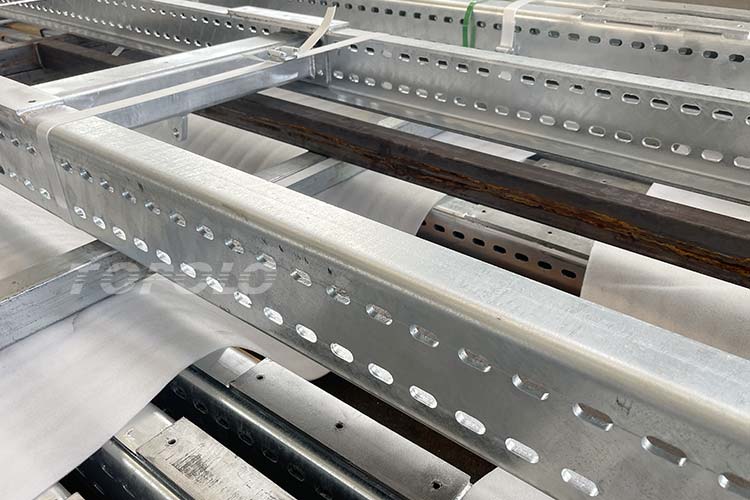
- Weight Reduction Effect: Each meter of chassis frame can be reduced by 3–5 kg. For a 10-meter-long chassis, this results in a total reduction of 30–50 kg. Without lowering load capacity, this improves the vehicle’s payload-to-weight ratio (the amount of cargo carried per unit of self-weight), thereby indirectly reducing fuel consumption. (For commercial vehicles, a 10% reduction in self-weight can lower fuel consumption by 5–8%.)
- Strength Enhancement: Drill hole positions are carefully arranged to avoid stress concentration zones. In addition, the design incorporates rounded hole edges (to eliminate sharp corners that cause stress concentration), which enhances local fatigue resistance and reduces the risk of “fatigue cracks” caused by long-term vibration and jolting.